
Works to IICRC S520
Every project follows the IICRC S520 reference for professional mold remediation.
Florida Mold-Services Framework IICRC S520 Reference
(305) 655-3290 Hablamos Español
Hialeah · Remediation
Full IICRC S520 Level I–V remediation across Hialeah and Miami-Dade — containment, source removal, structural drying, and independent clearance. Florida Chapter 468 framework on every project.
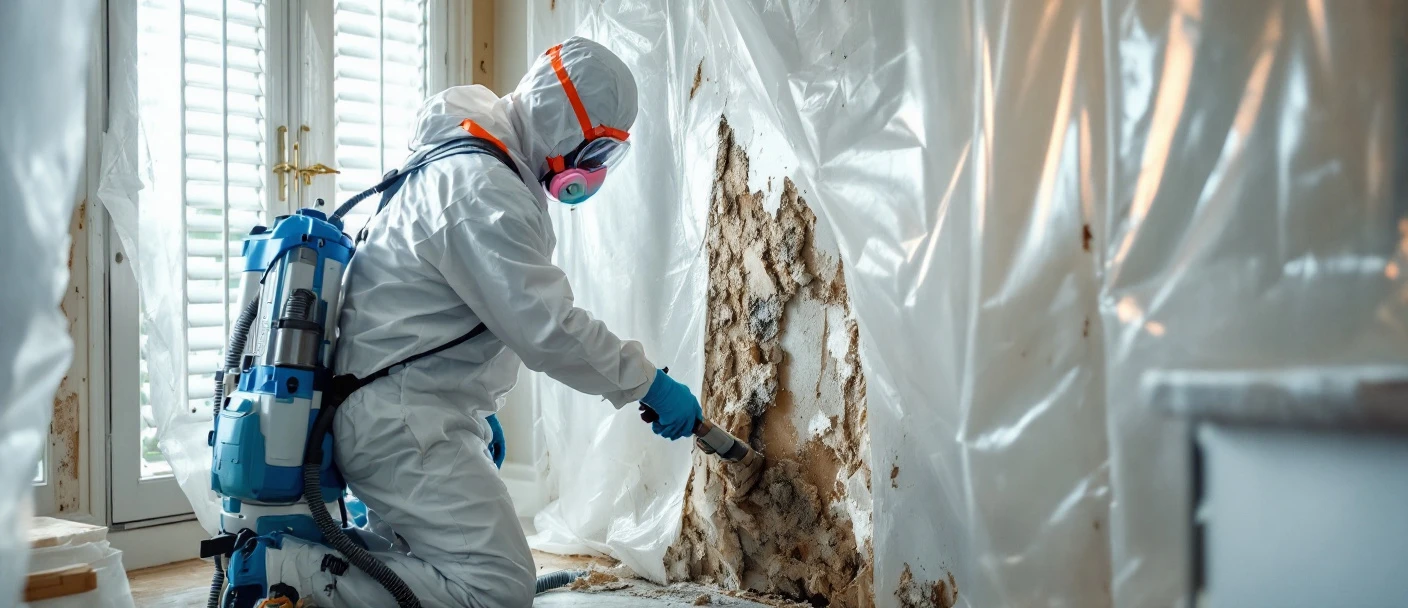
Mold remediation is not the same as mold cleaning. The IICRC S520 reference standard defines remediation as the structured removal of mold-affected materials and the return of the affected area to background spore levels — a process that requires containment, physical source removal, drying, and independent clearance. Surface treatments, bleach application, and encapsulation do not constitute remediation under the S520 standard. Every project we perform in Hialeah follows the S520 workflow alongside Florida's Chapter 468 Part XVI mold-services framework.
How remediation works
Remediation is structured work, not improvisation. Six discrete phases — each with defined entry and exit criteria — form the IICRC S520 reference workflow. The phases below describe what happens on a typical Hialeah project from your first call to the final clearance letter.
A Florida-licensed mold assessor conducts a moisture survey, thermal imaging scan, and visual inspection. The assessor produces a written scope of work specifying affected materials, IICRC S520 remediation level, containment requirements, and clearance criteria. Florida Chapter 468 Part XVI requires this assessor to be a separate entity from the remediation crew.
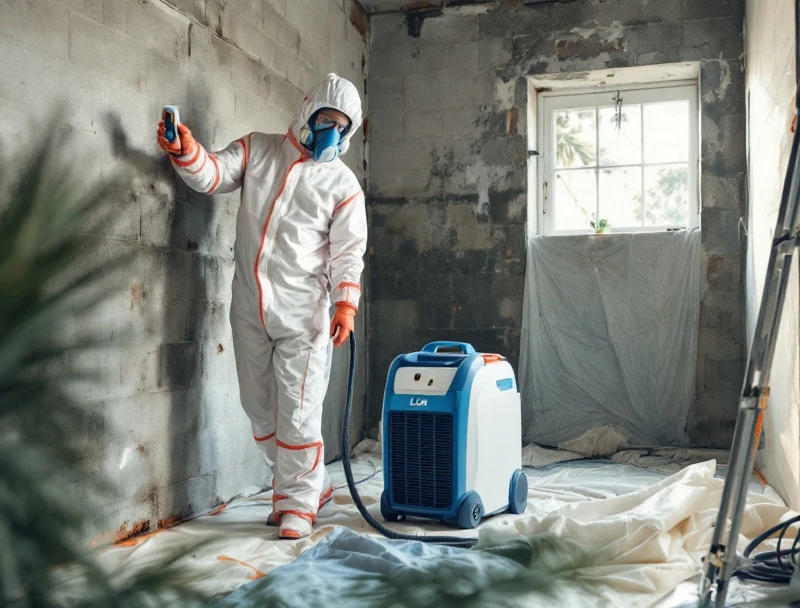
Six-mil poly-sheeting barriers isolate the affected zone. A negative-air machine maintains lower pressure inside the containment so airborne spores cannot migrate to clean areas. Critical barriers seal off HVAC supply and return registers in the work area. A decontamination chamber is staged at the containment entry for technician entry and exit.
Contaminated porous materials — drywall, fiberglass insulation, carpet pad, mold-damaged wood — are physically removed and bagged in two-layer 6-mil poly bags for disposal. Semi-porous and non-porous surfaces receive HEPA vacuuming. The S520 reference is explicit: bleach and surface antimicrobials do not constitute remediation of porous materials.
After demolition, structural surfaces are HEPA-vacuumed to remove residual spores and dust. EPA-registered antimicrobial agents are applied to studs, framing, and concrete-block surfaces. Air scrubbers run continuously to filter the work-area air through HEPA media rated for 0.3-micron particle capture.
Commercial dehumidifiers and high-velocity air movers dry framing, concrete block, and subfloor assemblies. Moisture readings are logged daily against IICRC S500 thresholds. Drying is not complete until readings reach industry-standard targets — in Hialeah's high-humidity climate, this typically requires 3–5 days for concrete block and 24–48 hours for wood framing.
A separate Florida-licensed mold assessor — not the remediation crew — conducts the clearance inspection. Air sampling, surface inspection, and moisture readings confirm the work area is within background levels. You receive a complete file: scope of work, daily logs, pre- and post-remediation photos, antimicrobial product data sheets, and the clearance letter.
Substrate-specific scopes
Different materials require different remediation strategies under the IICRC S520 framework. Porous materials with confirmed mold growth must be physically removed. Semi-porous materials can sometimes be treated in place. Non-porous materials are cleaned and HEPA-vacuumed. Below are the substrate-specific scopes most common in Hialeah remediation projects — most projects involve a combination of two or three scopes within a single containment zone.
Studs, joists, and rafters are semi-porous — they can sometimes be treated in place rather than replaced. Treatment begins with HEPA vacuuming to remove surface spores, followed by sanding or wire-brushing if surface staining is visible, then antimicrobial application. Wood that is structurally compromised by rot (not just stained) must be replaced.
Plywood and OSB subflooring frequently develops mold after water events. The S520 reference treats subfloor as semi-porous: surface mold is removed via HEPA vacuuming and antimicrobial treatment, but structurally compromised material is cut out and replaced. Carpet and pad over a mold-contaminated subfloor are always removed and disposed.
Roof-deck sheathing exposed to rain through cracked tile, missing ridge vent caps, or storm damage develops mold quickly in Hialeah's August humidity. Attic remediation typically combines sheathing treatment with ventilation correction. See our dedicated attic sheathing remediation service for full scope details.
Evaporator coils, drain pans, plenums, and air handler interiors are addressed under the NADCA ACR 2021 protocol alongside the IICRC S520 framework. Coil cleaning, drain pan replacement, and component disinfection are coordinated so the system does not redistribute spores during structural remediation. See our ductwork remediation service.
Carpet and pad over mold-contaminated surfaces are always removed — porous textile materials cannot be remediated to S520 standards. Upholstered furniture, fabric drapery, and mattress materials in heavily affected areas typically warrant disposal. Hard-surface items (wood furniture, electronics) can usually be HEPA-cleaned and saved.
Before any source removal begins, an independent mold assessment establishes the written scope of work. This is not optional under Florida Chapter 468 — and it is the document your adjuster will want to see first if you are filing a claim.
Hialeah cost estimator
The calculator below applies IICRC S520 scope variables — affected square footage, condition, substrate, water source, and ZIP zone — to produce an initial cost range for your situation. This is an estimate only; a written quote from a licensed assessor is the only accurate scope-based number for your specific home.
Hialeah Cost Estimator
An IICRC S520 scope-based estimate for Hialeah projects. Estimates only — call for a Hialeah-local quote.
Estimate is for the listed scope at the selected size. Final pricing depends on accessibility, demolition extent, and drying days verified on-site.
Hialeah cost reference
The twelve scenarios below reflect typical Hialeah project ranges across the IICRC S520 level structure. Concrete-block construction, slab-on-grade foundations, and Hialeah's wet-season humidity all influence drying time and cost relative to national averages.
Surface mold removal on tile, grout, or caulk (under 10 sq ft)
Single bathroom remediation — drywall + tile cavity scope
Single bedroom drywall remediation (under 25 sq ft affected)
Living room or kitchen scope including insulation R&R
Attic-only sheathing remediation + ventilation correction
Concrete-block wall scope (block + furring + drywall)
Multi-room post-leak remediation (Level III containment)
HVAC system component remediation (NADCA ACR scope)
Insulation removal and replacement only
Subfloor remediation under existing flooring
Post-hurricane whole-house (Level IV–V scope)
Independent clearance testing (billed by assessor)
Most-common single-room scope
IICRC Level I–II with drywall replacement
Multi-room post-leak scope
IICRC Level III containment
Independent clearance fee
Required separately by FL Ch. 468
Coverage map
We serve all seven Hialeah ZIP codes and adjacent Miami-Dade communities. Response windows vary by zone — call to confirm same-day or next-morning availability for your address.
Why us
Every project follows the IICRC S520 reference for professional mold remediation.
Aligned with Florida's Chapter 468 Part XVI mold-services framework, including the assessor-remediator separation rule.
HVAC work follows the NADCA ACR 2021 protocol — coil, drain pan, plenum, ductwork, and air handler in scope.
Post-remediation verification is arranged through a separate Florida-licensed mold assessor.
Post-storm and water-damage workflows refined across South Florida hurricane seasons.
Scope-based estimates with cost ranges before any demolition begins.
Moisture log, photographs, and source identification prepared in adjuster-ready format.
Post-remediation verification arranged through a separate Florida-licensed assessor.
Same- or next-day on-site response across Hialeah ZIP zones and inner Miami-Dade.
Written scope of work that maps to IICRC S520 Condition language before any demolition.
Standards in practice
Florida does not require a state-administered "S520 stamp" on completed mold work — but every reputable remediator references the standard, and every insurer-paid claim expects the documentation that S520 compliance produces. The comparison below captures the practical differences between an S520-referencing project and a non-compliant one.
| Factor | IICRC S520-Compliant | Non-Compliant |
|---|---|---|
| Standard reference | IICRC S520 (current edition) | Vague "professional" or none cited |
| Florida Ch. 468 licensing | Separate assessor + remediator licenses | Single company performs both roles |
| Written scope of work | Detailed scope by licensed assessor | Verbal estimate over the phone |
| Containment level (S520) | Level I–V appropriate to scope | No containment or basic poly sheeting |
| Bleach used on porous materials | Never — porous materials are removed | Bleach applied to drywall/wood |
| Moisture documentation | Daily moisture logs to S500 targets | No moisture monitoring |
| Post-remediation clearance | Independent assessor air sampling | Self-clearance or none |
| Documentation for insurance | Full package — scope, logs, photos, letter | Invoice only |
If you are interviewing remediators, ask these eight questions before signing any authorization. A compliant remediator answers all eight clearly and in writing. A non-compliant operator typically deflects on the assessor separation, the written scope, and the clearance documentation — which are the three items most important to your insurance claim and your future resale.
Common misconception
Bleach is the most commonly recommended household mold treatment — and the most commonly misused. The IICRC S520 reference is explicit that bleach is not an effective remediation agent for porous materials such as drywall paper, wood framing, fiberglass insulation, or carpet padding. Several factors drive this conclusion.
First, bleach is an aqueous solution: it is mostly water with a small percentage of sodium hypochlorite. Applied to porous materials, the water component soaks into the material while most of the active ingredient evaporates or breaks down on the surface. The active ingredient does not penetrate to reach the root structure of an established mold colony — meaning the colony survives, often emerging again within weeks as the material dries.
Second, bleach removes visible discoloration without removing the colony itself. This is what creates the appearance of "cleaning" — but a surface-treated drywall panel with a bleached stain still contains the same mold mass that was there before treatment. For a licensed assessor performing a post-treatment inspection, this is worse than no treatment: visual evidence of the scope is destroyed while the contamination remains.
Third, bleach can complicate laboratory analysis. Air and surface samples taken from an area where bleach has been applied may show artificially suppressed spore counts for several hours, only to rebound as the colony continues to release spores. Insurance adjusters and licensed assessors are aware of this — and most policies and clearance protocols treat recent bleach application as a reason to delay sampling or expand the scope.
The correct approach for porous materials with confirmed mold growth is physical removal under containment — the S520 reference workflow. Non-porous and semi-porous surfaces (concrete block, sealed wood, glass, metal) can be cleaned with appropriate antimicrobial agents, but the agent selection is based on EPA registration for the species involved and the substrate type. For confirmed Stachybotrys situations, this specialized scope is the focus of our toxic-mold removal service.
Hialeah construction context
Hialeah's predominant single-family housing type is concrete block on a slab-on-grade foundation. The construction sequence is concrete-masonry-unit (CMU) walls, then furring strips fastened to the interior face, then drywall on the furring. This assembly type has implications for mold remediation that differ significantly from the wood-frame construction common in northern states.
Concrete block is hygroscopic — it absorbs moisture from the air during wet-season conditions and releases it during dry-season conditions. In Hialeah's climate, where outdoor dew points exceed 70 °F for six months of the year, block walls remain moisture-saturated for extended periods. When a water event (roof leak, plumbing leak, storm-driven rain) occurs, the block absorbs the additional moisture and releases it slowly back into the interior through the furring and drywall assembly.
This characteristic creates two challenges for remediation. The first is detection: moisture can be present in the block long after the drywall surface appears dry. A moisture meter reading on drywall alone is not sufficient — measurements must be taken on the block itself, often requiring a small cut-out behind the drywall. The second challenge is drying time: block requires 3–7 days of active dehumidification to reach target moisture readings, compared with 24–48 hours for wood framing in a similar scope.
Slab-on-grade construction adds another consideration. Unlike wood-frame homes with crawl spaces or basements, Hialeah's slab homes have no plenum beneath the floor. Moisture from a slab leak or from below-grade water intrusion has no escape path downward — it moves upward through wall cavities and across floor finishes. Mold on baseboards, on lower wall sections, or on flooring near exterior walls is frequently a signal of slab-related moisture that requires investigation beyond the visible surface area.
Post-storm remediation
Atlantic hurricane season runs from June 1 through November 30 each year — a six-month window that overlaps almost entirely with Hialeah's mold-favorable wet season. Even when a storm does not make a direct hit on Miami-Dade, wind-driven rain, partial roof damage, and tropical-system-related power outages frequently create the conditions for mold growth in Hialeah homes within days of the event.
The most common post-storm scenarios we encounter in Hialeah involve three patterns: roof damage allowing rain intrusion into the attic and upper walls, window or door seal failure causing rain entry around openings, and extended power outages causing AC system shutdown with ambient humidity reaching 80–90% RH inside the conditioned space. Each of these creates moisture conditions that meet or exceed the IICRC S520 24–48 hour threshold for mold growth on porous materials.
The most cost-effective post-storm decision a Hialeah homeowner can make is to call for an assessment within 24 hours of the event — before visible mold appears. Drying a wet but uncolonized space prevents mold growth entirely and costs a fraction of a remediation project. By the time visible mold appears (typically 48–72 hours after the moisture event in Hialeah's August humidity), the scope has expanded to include physical removal of porous materials, and the cost has increased accordingly.
Get started
Tell us what you are seeing — the type of moisture event, the rooms affected, and your ZIP code. We will explain the assessment process, what it costs, and when we can schedule. For active flooding or post-storm urgent situations, call directly at (305) 655-3290.
60-second form. We call you back.
We respond during business hours, usually within an hour.
Frequently asked questions
Mold removal implies eliminating every spore, which is not possible — mold spores are present in all indoor and outdoor air. Mold remediation, the term used in the IICRC S520 standard, means returning the affected area to background spore levels and removing physically affected materials. A licensed remediator following S520 references this distinction in the written scope of work and in the post-remediation clearance criteria.
Florida policies typically cover mold remediation when it results from a sudden, accidental water event — a burst pipe, a roof failure during a named storm, or an appliance overflow. Gradual or maintenance-related mold is usually excluded. Documentation matters: a written scope of work from a licensed assessor, pre-remediation photos and moisture readings, the remediation invoice with itemized methods, and the clearance letter from a separate licensed assessor are the standard package adjusters need.
Most single-room projects take 1–3 working days; multi-room scopes take 3–7 days. Drying time depends on substrate: drywall and wood typically reach target moisture in 24–48 hours, while concrete-block walls can take 3–7 days. Hialeah's wet-season ambient humidity (May through October) can extend drying timelines by a day or two. You receive a written schedule and daily moisture logs throughout the project.
The IICRC S520 reference is explicit: bleach is not an effective mold remediation agent for porous materials. Bleach is an aqueous solution that does not penetrate paper-faced drywall or wood framing to reach the root structure of the colony. Surface application leaves the colony intact while removing visible discoloration, which prevents proper assessment of the actual scope. Porous materials with confirmed mold growth must be physically removed under the S520 framework — surface treatment is not a substitute.
For contained single-room projects, most families can remain in unaffected areas. For Level III and higher containment work (multi-room, whole-house, or post-storm scopes), temporary relocation is recommended for occupants with respiratory conditions, children under 12, elderly residents, and people with immunosuppression. The assessor will advise based on your specific scope, containment configuration, and household composition.
Clearance involves three components: visual inspection, moisture readings, and air sampling. The visual inspection confirms that physically affected materials have been removed and that surfaces are dust-free. Moisture readings confirm that drying has reached IICRC S500 targets and that materials are at equilibrium with surrounding building materials. Air sampling (spore traps) compares the remediated area to outdoor baseline samples — the work area should be at or below outdoor background spore concentrations. All three must pass for clearance.
Standard mold remediation that does not involve structural alteration, electrical, or plumbing work generally does not require a Hialeah building permit. When remediation involves replacing structural framing, modifying load-bearing assemblies, replacing electrical wiring damaged by water, or altering plumbing, the relevant trade permit is required from the City of Hialeah Building Department. Your remediator should advise you when a permit will be needed before the project begins.
Under Florida Chapter 468 Part XVI, the licensed mold assessor sets the scope of work and the licensed remediator executes it. If a scope dispute arises during the project (for example, the remediator discovers hidden damage requiring expanded scope), the assessor must return to evaluate and amend the written scope before additional work proceeds. You are not obligated to authorize out-of-scope work — and your insurer typically will not cover it without an amended assessor scope.
Many Hialeah remediators provide a written scope-based estimate free of charge as part of the initial assessment. Some assessors charge a flat-rate assessment fee (typically $250–$450 in Hialeah) that includes the visual survey, moisture mapping, thermal imaging, and the written scope. Air or surface sampling adds laboratory costs (typically $80–$150 per sample). Always ask in advance whether an assessment includes the written scope and whether it is independent of any remediation upsell.
Properly remediated mold does not return on its own — but an uncorrected moisture source can cause new growth in the same or adjacent area. The written scope of work should always identify and document the moisture source: a roof leak, a plumbing leak, condensation from a poorly insulated cold supply duct, or chronic high indoor humidity. If the moisture source is not corrected as part of the remediation, mold can recur within weeks. Reputable remediators include moisture-source correction in the scope or refer you to the appropriate trade (roofer, plumber, HVAC) before completing remediation.
Same-day response for urgent post-storm and active-flood scopes. Standard assessment scheduling within 24–48 hours.